%201.png)

We challenge norms, push boundaries and redefinepossibilities. Join us to facilitate a pain free, activelifestyle and achieve peak performance.


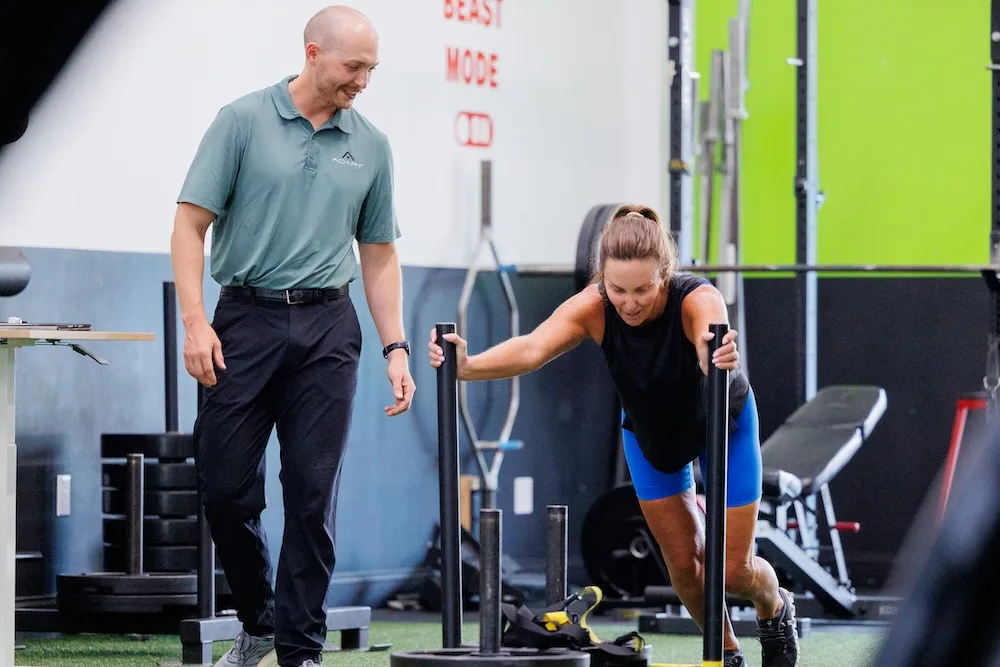
Speed is one of the most sought-after athletic qualities — and one of the most misunderstood. Most athletes assume speed is something you either have or you don't. The fastest person on the team was born that way, and the slower ones just have to accept their limitations and focus on other things. This is one of the most persistent and damaging myths in athletic development, and it's responsible for keeping a lot of athletes from reaching their potential.
Speed is trainable. Not just marginally trainable — significantly trainable. The science of athletic speed development is well established, and the athletes who improve their speed most dramatically are the ones who train it systematically, with proper mechanics, appropriate loading, and a structured progression that builds the physical qualities underlying fast movement. At Guerrilla Performance & Recovery, speed and agility training is an integral part of the sports performance program — and the approach is grounded in exactly that kind of systematic, evidence-based development.
Why Speed Is a Physical Quality, Not Just a Talent
Speed is the product of several trainable physical and neuromuscular qualities working together. Force production — how much force a athlete can apply into the ground with each stride — is the primary determinant of acceleration. Ground contact time — how quickly an athlete can transition from landing to pushing off — determines how efficiently that force is expressed. Stride length and stride frequency interact to determine maximum velocity. And the mechanics of acceleration, transition, and top-end speed are motor patterns that can be taught, refined, and ingrained with deliberate practice.
An athlete who addresses all of these qualities through structured training will get faster. The improvement may not turn every athlete into a world-class sprinter, but the magnitude of speed gain available through proper training is far larger than most coaches and athletes realize — and in a sport where fractions of a second determine outcomes, that improvement is enormously meaningful.
What Speed and Agility Training at Guerrilla Looks Like
Mechanical Assessment and Movement Quality
Before any speed work begins, the Guerrilla coaching staff assesses your current movement mechanics. How you accelerate, how you decelerate, how you change direction, and the specific mechanical inefficiencies or asymmetries in your movement patterns that are limiting your speed are all identified before programming begins. This assessment is what separates targeted speed development from generic cone drills — it ensures that the training directly addresses the factors limiting your specific speed output.
Acceleration Development
Acceleration — the ability to go from stationary or slow movement to top speed as quickly as possible — is the most sport-relevant expression of speed for the majority of athletes. Most athletic actions involve short bursts of acceleration rather than sustained maximum velocity running, which means that the ability to generate force rapidly from a standing or moving start is often more valuable than pure top-end speed.
Acceleration training at Guerrilla focuses on the neuromuscular factors that determine first-step quickness and the mechanical patterns that allow maximum force to be applied into the ground during the acceleration phase. Loaded and resisted acceleration work, plyometric training, and technical sprint drills are all used to develop this quality progressively.
Agility and Change of Direction
True agility — the ability to change direction quickly in response to a stimulus — is different from change-of-direction speed, which is pre-planned. Both are important for most sports, and both are trained specifically at Guerrilla. Change-of-direction mechanics, deceleration technique, and reactive agility drills that require the athlete to respond to visual or auditory cues are all components of the agility development program.
Deceleration is particularly important and often neglected. The ability to stop quickly and safely is both a performance quality — you can't change direction at full speed without first decelerating — and an injury prevention factor, since the forces involved in rapid deceleration are among the highest experienced during athletic movement and a primary mechanism for ACL and lower extremity injuries.
Elasticity and Reactive Strength
The stretch-shortening cycle — the body's ability to store and rapidly release elastic energy during movement — is a major contributor to speed and agility performance. Athletes with high reactive strength can use the elastic properties of their tendons and fascial system to generate more force with less metabolic cost, move more quickly between ground contacts, and absorb and redirect force more efficiently during change-of-direction movements.
Guerrilla's speed and agility programming includes carefully dosed plyometric and reactive strength work designed to develop this quality without overloading the tendons and connective tissue in ways that lead to injury. Progression is managed based on the athlete's current reactive strength capacity and their tolerance for this type of loading.

We challenge norms, push boundaries and redefinepossibilities. Join us to facilitate a pain free, activelifestyle and achieve peak performance.